In many Ayurvedic households, dates soaked in ghee are a familiar winter preparation, though far from a universal one. It looks like a simple snack. It isn’t. This pairing is one of the oldest applications of a concept called anupana, and understanding why it works tells you a lot about how Ayurveda thinks about food as medicine.
What Does Anupana Actually Mean?
Anupana is the Sanskrit term for a carrier substance, something taken alongside a primary food or herb to change how the body absorbs and uses it. Water, milk, honey, and warm water are common anupanas. Ghee holds a special place among them because it’s easily digestible, which lets it pull nutrients from other foods deeper into the tissues, or dhatus, according to classical texts.
Dates and ghee benefits show up specifically because of this carrier relationship. Dates alone are dense in natural sugars, potassium, and fiber. Ghee alone supports digestion and lubricates the gut lining. The use of ghee alongside dates also provides a useful Ayurvedic context for understanding formulations such as Eenthapazha Rasayanam, which combines dates with ghee and other ingredients.
The Nutrient Logic Behind Dates Soaked in Ghee
Here’s where the science and the tradition start to overlap a little. Dates contain their broader nutrient makeup, including small amounts of vitamin A precursors and certain polyphenols. Fat-soluble means they need a lipid to dissolve in before the small intestine can take them up efficiently. Ghee, being almost entirely fat, provides exactly that medium.
This is also why Ayurvedic cooks rarely serve dates plain when the goal is deeper nourishment rather than just a quick snack. Dates and ghee work as a pair specifically because soaking softens the fruit and lets a thin layer of fat coat the flesh. Traditional practitioners describe this as making the date’s rasa, its essential nutritive quality, easier for the body to extract.
How Ayurvedic Kitchens Traditionally Prepare This Combination
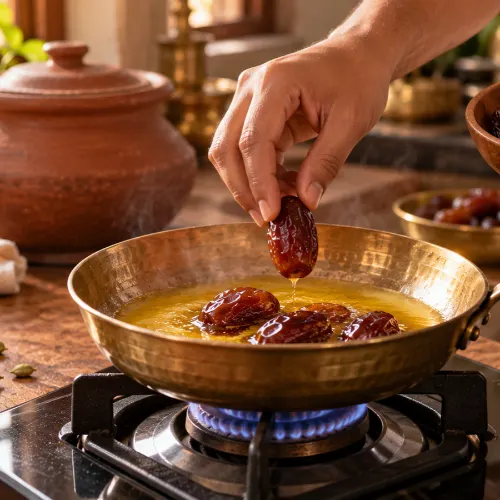
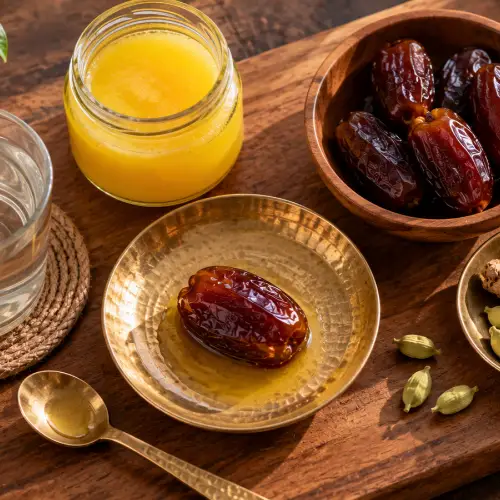
The method itself is unhurried, which fits the broader Ayurvedic philosophy of slow, deliberate food preparation. Pitted dates go into a small amount of warm, not hot, ghee. They rest, absorbing the fat gradually rather than frying in it. Some households add a pinch of dry ginger or cardamom, both considered digestive aids, or deepanas, in classical texts.
Timing matters too. Many practitioners recommend this preparation in the early morning on an empty stomach, when agni, the digestive fire, is considered strongest and best able to process a concentrated, fat-rich food. Others suggest it during colder months or seasonal transitions, when the body is thought to need more grounding, warming nourishment.
Who This Pairing Suits and Who Should Be Cautious
This is where an honest YMYL disclosure matters more than a marketing pitch. Dates soaked in ghee are calorie-dense and rich in natural sugars and saturated fat. People managing diabetes, cardiovascular conditions, or weight-related concerns should treat this as a topic to raise with their doctor or an Ayurvedic physician before adding it to a daily routine, not as a blanket recommendation.
For generally healthy adults without these concerns, occasional inclusion as part of a balanced diet is unlikely to cause harm, but “occasional” and “balanced” are doing real work in that sentence. Ayurveda itself was never meant to prescribe one remedy for every body; it categorizes people by constitution, or prakriti, precisely because what nourishes one person can unbalance another.
Bringing This Practice Into a Modern Kitchen
You don’t need a shelf of Sanskrit texts to try this thoughtfully. Start small: a single date, warmed gently in a teaspoon of good quality ghee, eaten slowly rather than swallowed on the run. Pay attention to how your digestion responds over a few days before making it a habit.
What’s worth remembering is that this isn’t a shortcut or a miracle combination. It’s a slow, considered piece of food wisdom that predates modern nutrition science by centuries, and one that modern research is only beginning to explain in its own terms.
Final Thoughts
Dates soaked in ghee aren’t a trend chasing attention on social media. They’re a small, specific example of how Ayurveda pairs foods deliberately rather than randomly. If you’ve tried this combination yourself, what did you notice, and did it change how you think about food pairing in general?
Disclaimer
This article is for general informational purposes only and isn’t a substitute for medical or professional Ayurvedic consultation. Anyone with an existing health condition, or currently on medication, should speak with a qualified doctor or Ayurvedic practitioner before adding dates soaked in ghee to their diet.
FAQ
Depends on what you’re after. Plain dates give you quick energy and fiber. Soaking them in ghee is more about the Ayurvedic idea of better nutrient carrying, not a guaranteed nutritional upgrade backed by hard clinical data.
Traditional practice leans towards a few hours minimum, often overnight. Anything less and the ghee hasn’t really had time to soften the fruit or coat it properly.
Honestly, neither is guaranteed. It’s calorie-dense, so portion size matters a lot more than the pairing itself if weight is your main concern.
Talk to your doctor first. Dates are naturally high in sugar, and this isn’t a food swap to make on your own if blood sugar management is already a concern.
Most traditional guidance points to morning, on an empty stomach, when digestion is considered at its strongest. But this is a general principle, not a strict rule for every body type.
Medically reviewed by Dr. Arun Radhesh R. (BAMS, MBA), Chief Physician, Ayur Wakeup
Visiting Consultant, Govt. Ayurveda Hospital · Last reviewed: 18 April 2026